Example Independent Insights Articles
Here are some sample independent insight led articles
76 articles


Everything you need to know about liposomal delivery
Learn how liposomal delivery works, who benefits, and how to judge liposomal supplements in New Zealand.

The Hidden Tax on Every Supplement You Buy
Most shoppers compare supplements by milligrams and price per bottle. But the number that actually determines whether a supplement works - bioavailability - is nowhere on the label.
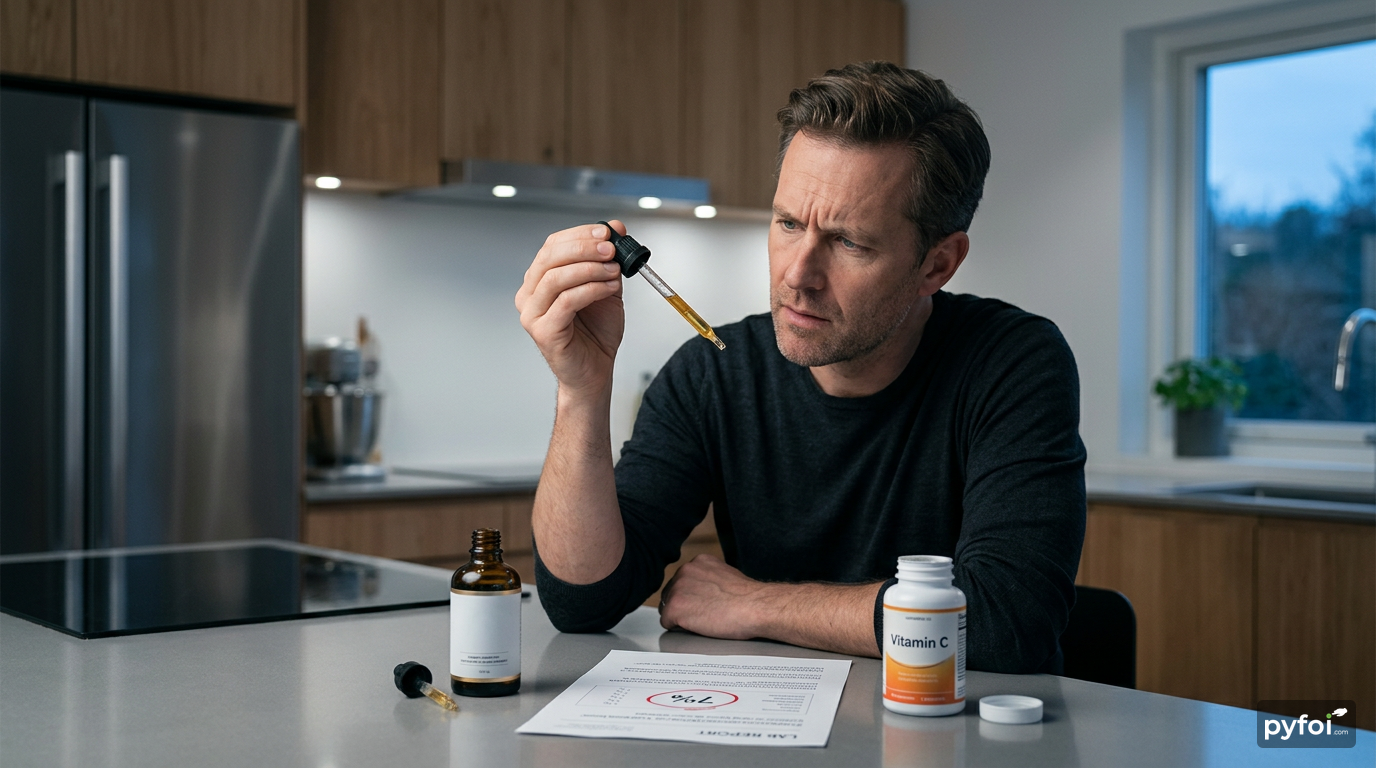
Paying Premium Prices for a Fake Liposomal Supplement?
Independent lab testing shows most liposomal supplements contain no real liposomes. Learn the four checks that separate genuine products from label-only fakes.

The Nutrient Gap Your Doctor Will Never Diagnose
A quarter of New Zealanders have inadequate zinc intake and a third are vitamin D deficient by winter. Learn why subclinical deficiency goes undiagnosed.
The Ageing Absorption Cliff After 50
After 50, your body absorbs less from every supplement you take. Learn why stomach acid loss, PPIs, and enzyme decline create a hidden nutrient gap.

Your Gut Is Quietly Sabotaging Your Supplements
64% of New Zealand adults have gut symptoms that silently reduce supplement absorption by 30-60%, making format choice more important than brand or dose.

Supplement Stacking Trap: Why More Is Less
Taking multiple supplements together creates absorption conflicts that reduce nutrient uptake. Learn how mineral competition wastes money and what formats avoid it.

The Start-Stop Supplement Trap That Costs You Thousands
Millions of supplement users quit because they feel nothing - then restart months later. The problem isn't the nutrient. It's how little of it your body ever absorbed in the first place.
Why Doubling Your Supplement Dose Is Not Doubling Your Results
Your body hits an absorption ceiling on most standard supplements. Escalating dose wastes money and delivers near-zero extra nutrient to your bloodstream.

Are You Trusting Regulations That Do Not Actually Exist?
New Zealand's supplement regulations date from 1985 and contain no provisions for liposomal claims. Every quality claim on the bottle is self-declared, with no pre-market approval and only complaint-driven enforcement.

The Double Deficit Hiding in New Zealand's Clean, Green Food
New Zealand's volcanic soils are naturally low in selenium, zinc, and iodine - meaning food grown here starts nutritionally behind. Standard supplements then fail to close the gap, creating a compounding deficit most Kiwis never see.

Is Your Liposomal Supplement Already Dead?
Liposomal supplements degrade through heat, light and oxidation before you open the bottle. Learn how to spot degraded products and protect your investment.
The Double Deficit Hiding in New Zealand's Clean, Green Food
New Zealand's volcanic soils are naturally low in selenium, zinc, and iodine - meaning food grown here starts nutritionally behind. Standard supplements then fail to close the gap, creating a compounding deficit most Kiwis never see.
What if your food was falling short before it reached your plate?
New Zealand's "clean and green" reputation is well earned. The air is fresh, the water is clear, and the farming practices are among the best in the world. So it is natural to assume that food grown here is nutritionally complete. Most Kiwis do.
Here is what very few realise: New Zealand's volcanic soils are naturally low in three critical minerals - selenium, zinc, and iodine [1]. That means food grown in this soil starts with a nutritional handicap before it even reaches your kitchen. And the way most people try to fix it does not actually work.
How much nutrition are we actually missing?
The gap is not subtle. Compare NZ-grown protein sources with their US equivalents: sirloin steak, lean beef mince, roasted chicken breast, and an egg from New Zealand provide roughly 42 micrograms of selenium. The same foods sourced from US soil deliver about 116 micrograms. That is a 64% deficit from food alone [2].
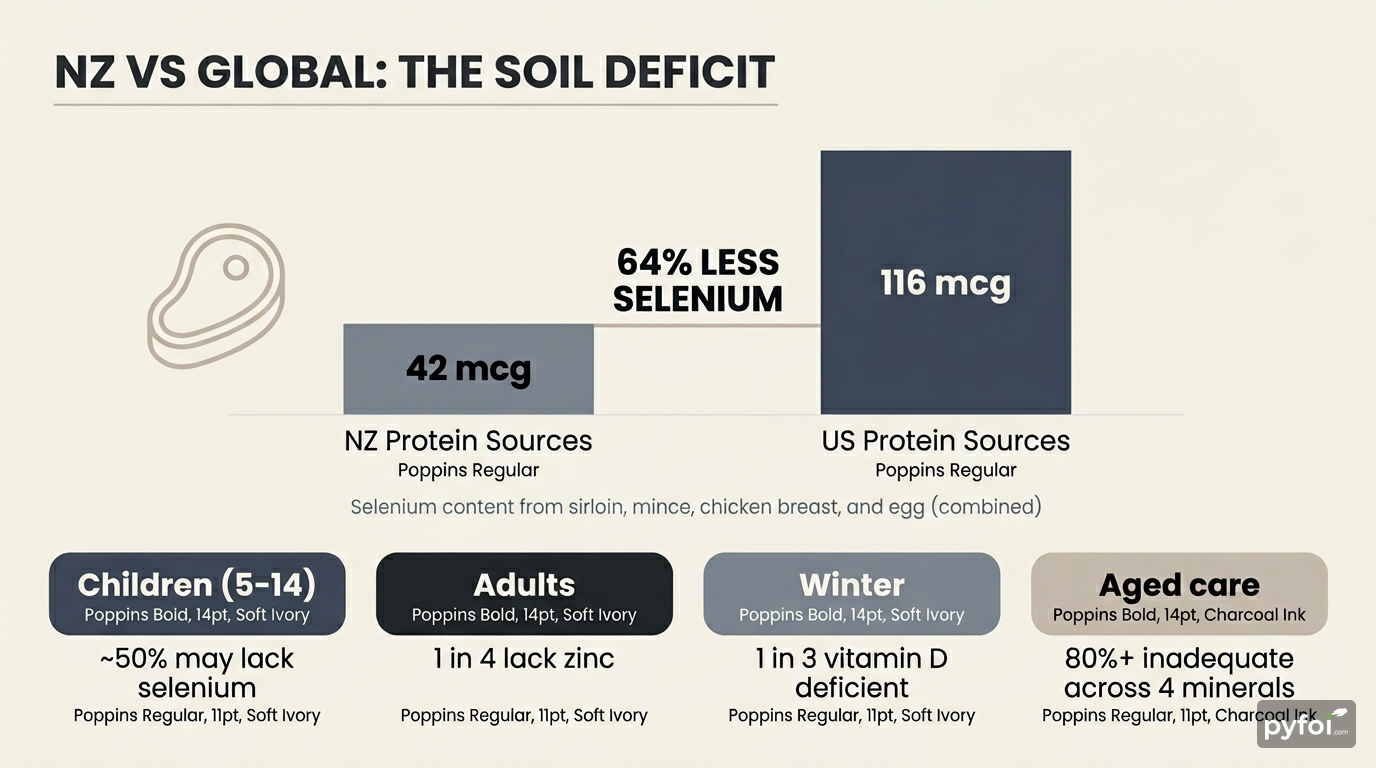
The downstream effects show up across the population:
- About half of New Zealand's 5-to-14-year-olds may not be getting enough selenium [2].
- One in four New Zealanders does not consume adequate zinc [3].
- One in three New Zealanders is vitamin D deficient by winter's end [4].
- More than 80% of NZ aged-care residents had inadequate intakes of calcium, selenium, magnesium, and vitamin B6 - even with supplementation [7].
These are not fringe numbers. They describe mainstream New Zealand.
Why doesn't supplementation fix it?
This is where the double deficit compounds. Many Kiwis who spot the gap do the sensible thing - they buy supplements. But standard oral supplements carry their own absorption problem. Average bioavailability for many common supplement forms sits at roughly 16% [5]. For every 100 milligrams on the label, your body may absorb just 16.
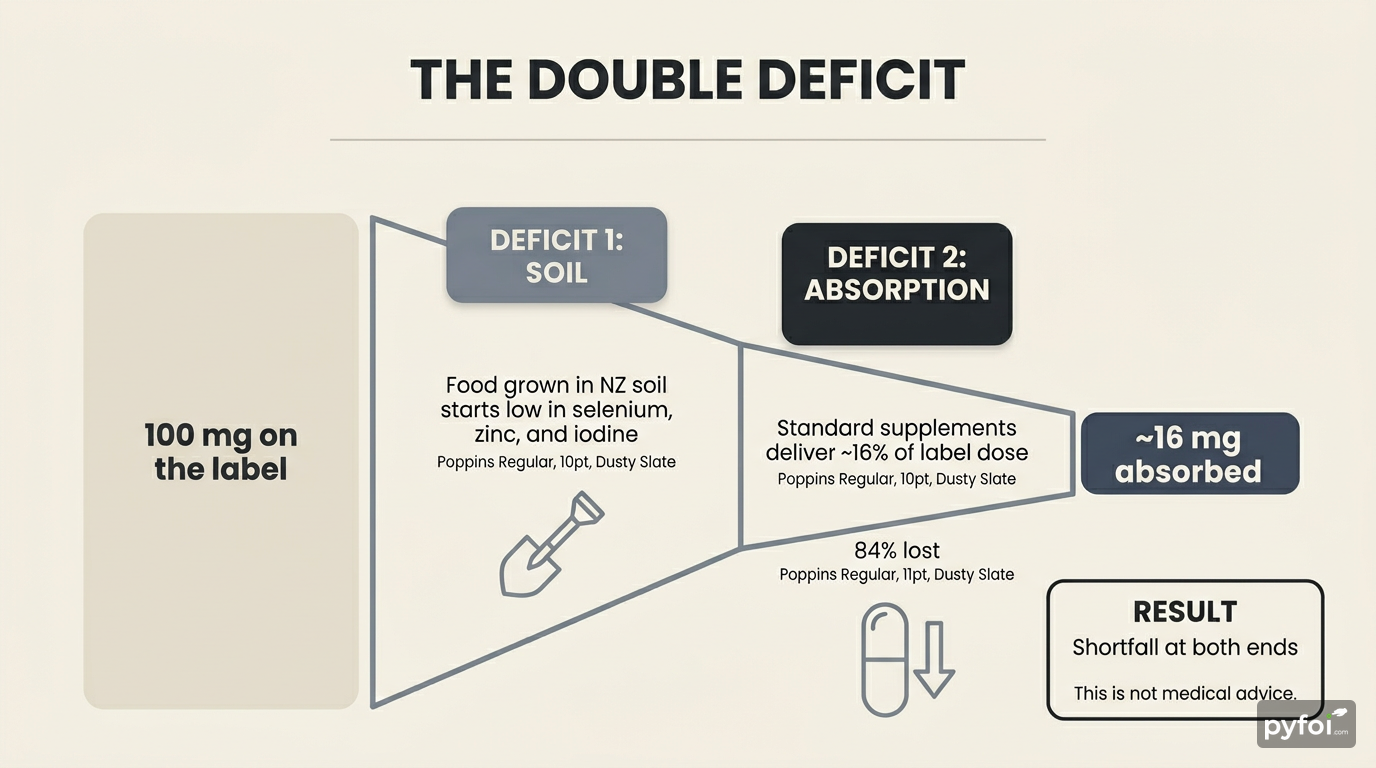
So the maths works against you twice. Your food starts short because of soil depletion. Then the supplement you buy to make up the difference delivers only a fraction of its stated dose. You end up falling short at both ends - without ever knowing it.
What does this actually feel like day to day?
Imagine you are a parent in Christchurch, cooking balanced meals with fresh local ingredients. Your kids eat well - lean meat, vegetables, eggs. You feel good about it. But your ten-year-old is tired all the time and keeps catching every cold that goes through school.
You try a children's multivitamin. After three months, nothing changes. You wonder whether supplements are a waste of money, or whether something else is going on. What is actually happening is invisible: the food was already low in selenium and zinc, and the multivitamin only delivered a fraction of its label claim into your child's bloodstream.
That quiet erosion - good intentions undermined by factors you cannot see on any label or plate - is the double deficit at work. It affects energy, immunity, and long-term health in ways that are easy to blame on stress, age, or bad luck.
How should you rethink your approach?
Instead of simply adding another supplement to the shelf, consider these factors before your next purchase:
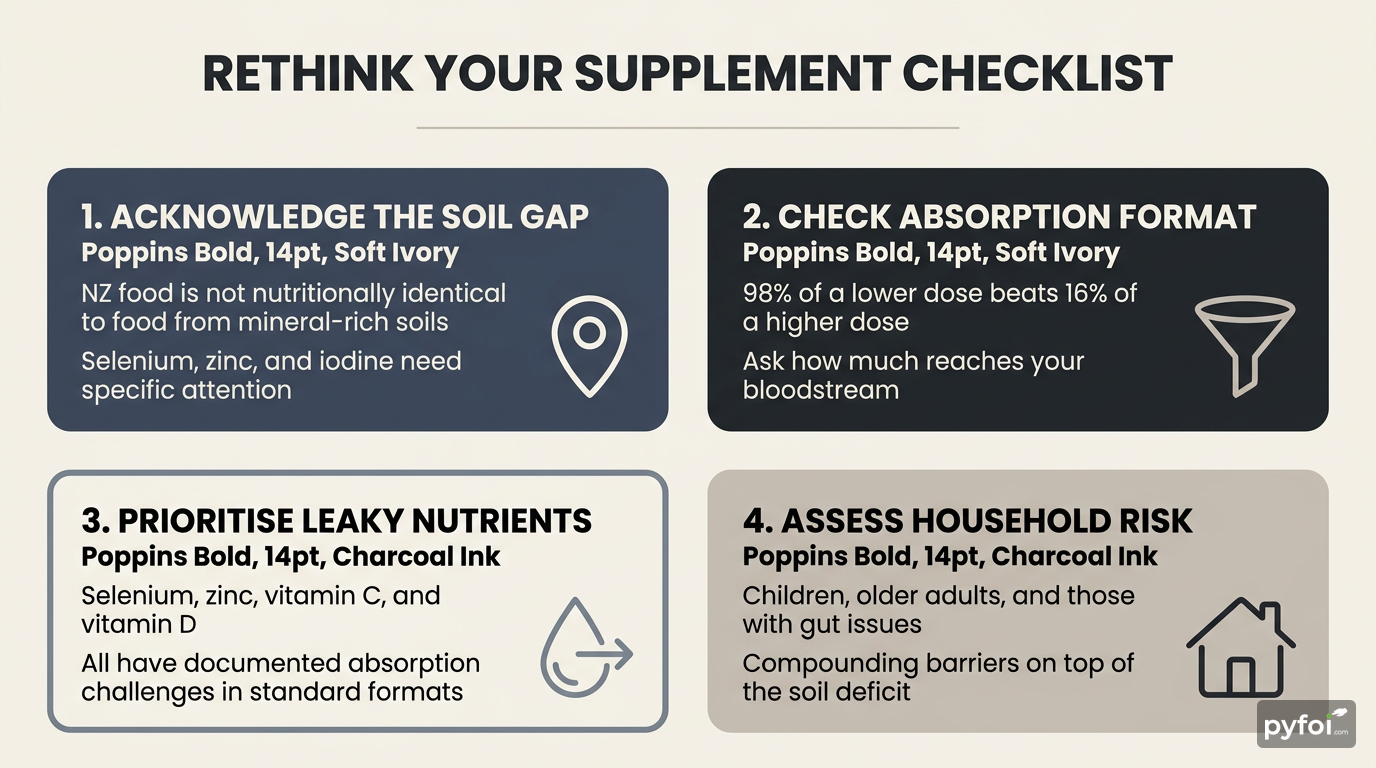
- Acknowledge the soil gap. NZ-grown food is excellent in many ways, but it is not nutritionally identical to food grown in mineral-rich soils. Selenium, zinc, and iodine deserve specific attention.
- Check absorption format, not just dose. A supplement that delivers 98% of a lower dose beats one that delivers 16% of a higher dose. Ask how much actually reaches your bloodstream.
- Prioritise the nutrients that leak most. Selenium, zinc, vitamin C, and vitamin D all have well-documented absorption challenges in standard oral formats.
- Look at household-level exposure. Children, older adults, and anyone with gut issues face compounding absorption barriers on top of the soil deficit.
What can you actually do about it?
Start by identifying your highest-risk nutrients. For most New Zealanders, selenium and zinc should be near the top of the list given the known soil deficiencies. Vitamin D is critical through the winter months.
Ask about delivery format before milligram count. A 2024 randomised controlled trial found liposomal vitamin C produced 27% higher peak plasma concentration and 21% greater total exposure versus standard vitamin C at the same dose [8]. Liposomal formats use a phospholipid layer to protect nutrients through digestion, improving how much reaches your bloodstream.
Do not assume your diet covers the basics. Even a well-balanced New Zealand diet leaves gaps that are geologically baked in. Supplementation is not optional for many Kiwis - but the format you choose determines whether it actually works.
Talk to your GP or pharmacist about testing. A simple blood test for selenium, zinc, and vitamin D can tell you exactly where you stand rather than guessing.
Factor in your life stage. Aged-care residents showed inadequate levels of multiple nutrients even with supplementation [7], which suggests standard formats may not be enough for older adults. Children in the 5-to-14 age bracket are another high-risk group [2].
The clean, green brand is real - but it does not extend to mineral content in the soil. Knowing that changes how you shop, what formats you choose, and whether your supplements are actually doing their job.
You may also be interested in these independent articles
Sources
- Minerals Lacking in NZ Soils - Liv's Apothecary
- New Zealand's soil lacks 3 essential minerals - About Health NZ
- How to avoid NZ's top dietary deficiencies - Healthy Food Guide NZ
- Priority nutrients to address malnutrition and diet-related diseases in Australia and New Zealand - Frontiers in Nutrition, 2024
- What is the absorption rate of supplements? - Ask The Scientists
- Inadequate Micronutrient Intakes in NZ Aged-Care Residents - Journal of Human Nutrition and Dietetics, 2025
- Liposomal delivery enhances absorption of vitamin C - PMC, 2024
© 2026 pyfoi. All rights reserved.