Example Independent Insights Articles
Here are some sample independent insight led articles
76 articles


Everything you need to know about liposomal delivery
Learn how liposomal delivery works, who benefits, and how to judge liposomal supplements in New Zealand.

The Hidden Tax on Every Supplement You Buy
Most shoppers compare supplements by milligrams and price per bottle. But the number that actually determines whether a supplement works - bioavailability - is nowhere on the label.
Paying Premium Prices for a Fake Liposomal Supplement?
Independent lab testing shows most liposomal supplements contain no real liposomes. Learn the four checks that separate genuine products from label-only fakes.

The Nutrient Gap Your Doctor Will Never Diagnose
A quarter of New Zealanders have inadequate zinc intake and a third are vitamin D deficient by winter. Learn why subclinical deficiency goes undiagnosed.
The Ageing Absorption Cliff After 50
After 50, your body absorbs less from every supplement you take. Learn why stomach acid loss, PPIs, and enzyme decline create a hidden nutrient gap.

Your Gut Is Quietly Sabotaging Your Supplements
64% of New Zealand adults have gut symptoms that silently reduce supplement absorption by 30-60%, making format choice more important than brand or dose.

Supplement Stacking Trap: Why More Is Less
Taking multiple supplements together creates absorption conflicts that reduce nutrient uptake. Learn how mineral competition wastes money and what formats avoid it.

The Start-Stop Supplement Trap That Costs You Thousands
Millions of supplement users quit because they feel nothing - then restart months later. The problem isn't the nutrient. It's how little of it your body ever absorbed in the first place.
Why Doubling Your Supplement Dose Is Not Doubling Your Results
Your body hits an absorption ceiling on most standard supplements. Escalating dose wastes money and delivers near-zero extra nutrient to your bloodstream.

Are You Trusting Regulations That Do Not Actually Exist?
New Zealand's supplement regulations date from 1985 and contain no provisions for liposomal claims. Every quality claim on the bottle is self-declared, with no pre-market approval and only complaint-driven enforcement.

The Double Deficit Hiding in New Zealand's Clean, Green Food
New Zealand's volcanic soils are naturally low in selenium, zinc, and iodine - meaning food grown here starts nutritionally behind. Standard supplements then fail to close the gap, creating a compounding deficit most Kiwis never see.

Is Your Liposomal Supplement Already Dead?
Liposomal supplements degrade through heat, light and oxidation before you open the bottle. Learn how to spot degraded products and protect your investment.
Are You Trusting Regulations That Do Not Actually Exist?
New Zealand's supplement regulations date from 1985 and contain no provisions for liposomal claims. Every quality claim on the bottle is self-declared, with no pre-market approval and only complaint-driven enforcement.
You pick up a supplement bottle in a New Zealand pharmacy. The label says "liposomal." You assume someone - Medsafe, the government, somebody - has verified that claim before it reached the shelf. It is a reasonable assumption. It is also completely wrong.
New Zealand's supplement regulations date from 1985. They predate liposomal technology, the internet, and the modern supplement industry. Unlike food or pharmaceuticals, dietary supplements require no pre-market approval whatsoever [1]. Every quality claim on that bottle is self-declared by the company selling it to you.
What does "regulated" actually mean for supplements here?
Most New Zealanders assume supplements undergo some form of government testing before sale. The reality is blunter than you might expect.
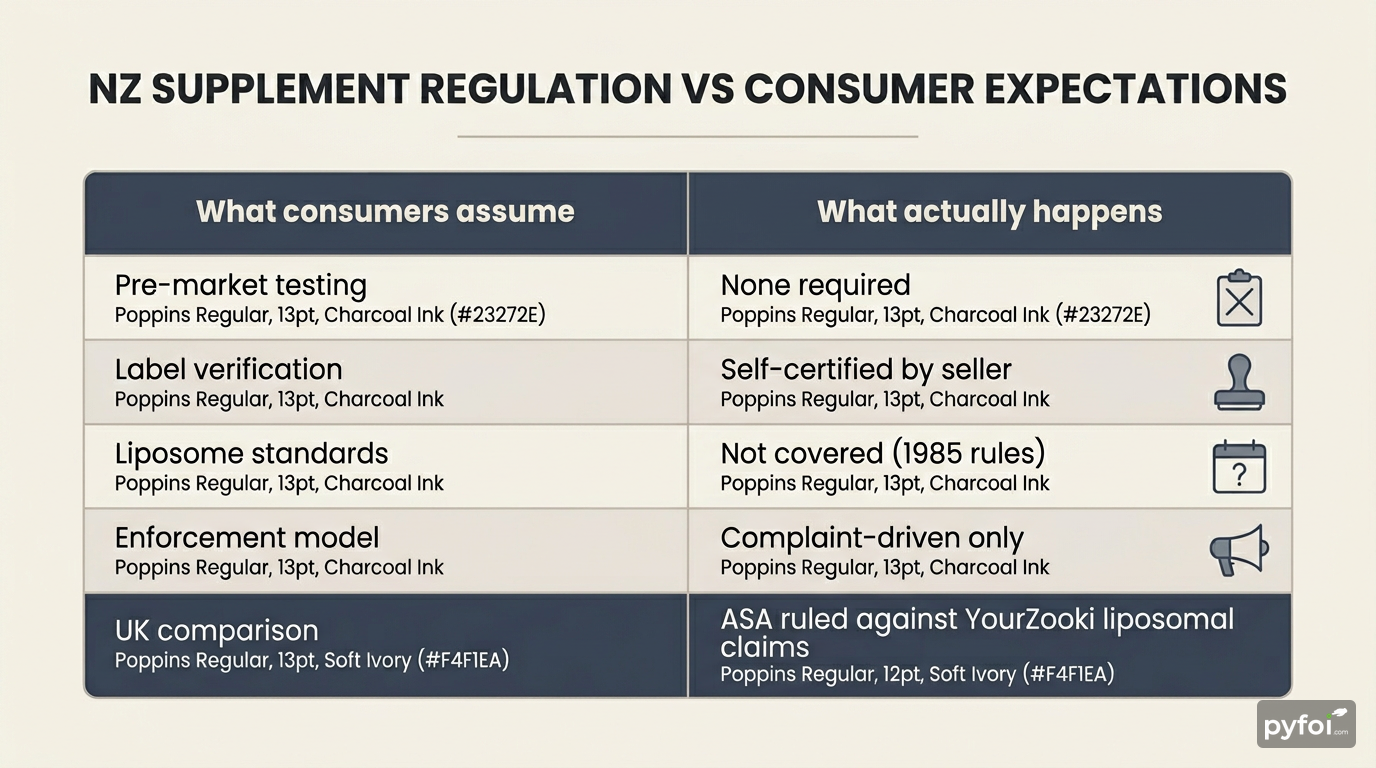
Medsafe states explicitly: "There is no pre-approval process for dietary supplements" [1]. Sponsors self-certify that their products meet the 1985 regulations. No one checks. The Dietary Supplements Regulations 1985 set maximum daily doses for some vitamins and minerals, but contain zero provisions for delivery technology claims, encapsulation efficiency, or liposomal verification [2].
That means the word "liposomal" on a New Zealand supplement label carries no regulatory weight at all. It is a marketing descriptor, not a verified manufacturing specification. The Commerce Commission requires claims to be accurate, but enforcement is complaint-driven - someone has to report a problem before anyone investigates [3].
Compare that to what happened in the UK. The Advertising Standards Authority ruled that YourZooki, one of the most prominent liposomal vitamin C brands globally, had not provided conclusive evidence its product actually contained liposomes [9][10]. That level of scrutiny simply does not exist in New Zealand's current framework.
How exposed are you right now?
The gap between what consumers believe and what the regulations deliver is significant:
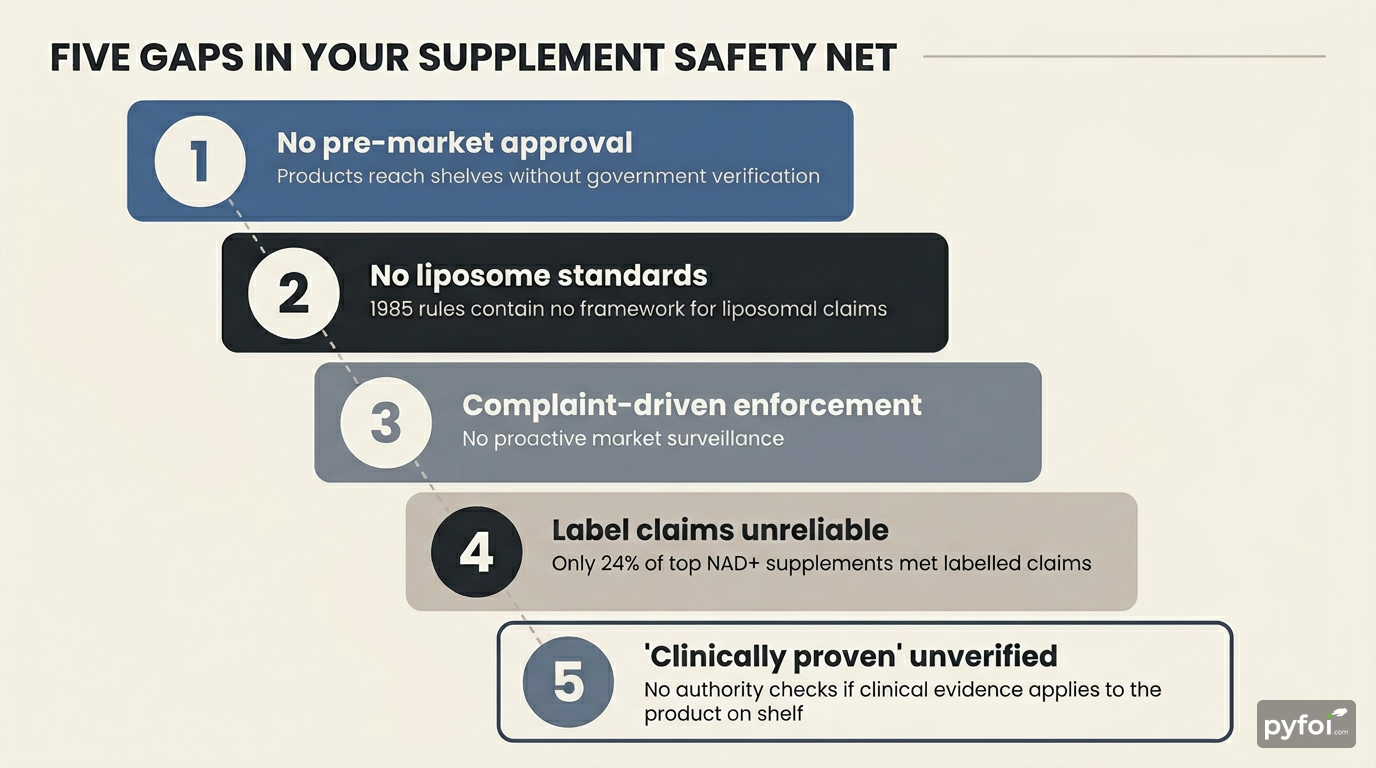
- No pre-market approval. Supplements reach shelves without any government body verifying ingredient quality, dose accuracy, or delivery-method claims [1].
- No liposome-specific standards. The 1985 regulations were written decades before liposomal delivery existed. They contain no framework for evaluating whether a "liposomal" product contains actual liposomes [2].
- Complaint-driven enforcement. The Commerce Commission acts on inaccurate claims, but only after someone complains [3]. Proactive market surveillance does not happen.
- Label claims are unreliable across the industry. A March 2025 analytical report found that only 24% of top-selling NAD+ supplements met their labelled claims [8]. That failure rate is industry-wide, not limited to fringe brands.
- "Clinically proven" drives purchases. Research shows this is the single most powerful phrase for consumer purchase intent [12] - yet no New Zealand authority verifies whether the clinical evidence behind that phrase applies to the specific product on shelf.
What this actually costs you
Picture yourself spending $50 a month on a liposomal vitamin C supplement. You chose it specifically because the label promised superior absorption. You take it daily through winter, confident you are getting measurable immune support.
Twelve months later you have spent $600. But no one verified the product contains functional liposomes. No regulatory body checked encapsulation efficiency. The "clinically proven" claim may reference a study on an entirely different formulation. You made a health decision based on claims no one in New Zealand is required to substantiate before sale.
That is not just a financial cost. It is a trust cost - compounding every month you continue buying on unverified label language.
How should you protect yourself?
Until regulation catches up, the responsibility sits with you. Use these filters before purchasing any supplement making delivery-technology claims:
- Demand third-party verification. Does the brand publish independent lab data - cryo-TEM imaging or dynamic light scattering - confirming liposomal structures actually exist in the finished product?
- Check encapsulation efficiency. Genuine liposomal products should report rates above 70%. If a brand cannot state this figure, they likely have not measured it.
- Scrutinise "clinically proven" claims. Was the study conducted on the exact product and formulation being sold, or on a different product using similar ingredients?
- Look for phospholipid-to-nutrient ratios. Functional liposomes require ratios between 1:5 and 1:20. Products outside this range cannot form effective vesicles.
What happens next - and what to do now
New Zealand's regulatory landscape is shifting. Cabinet decided in 2025 to regulate natural health products under separate standalone legislation, and the Medical Products Bill is expected in Parliament in 2026 [4][5]. Full implementation is estimated around 2030. The previous attempt - the Therapeutic Products Act - was repealed before ever taking effect [6].
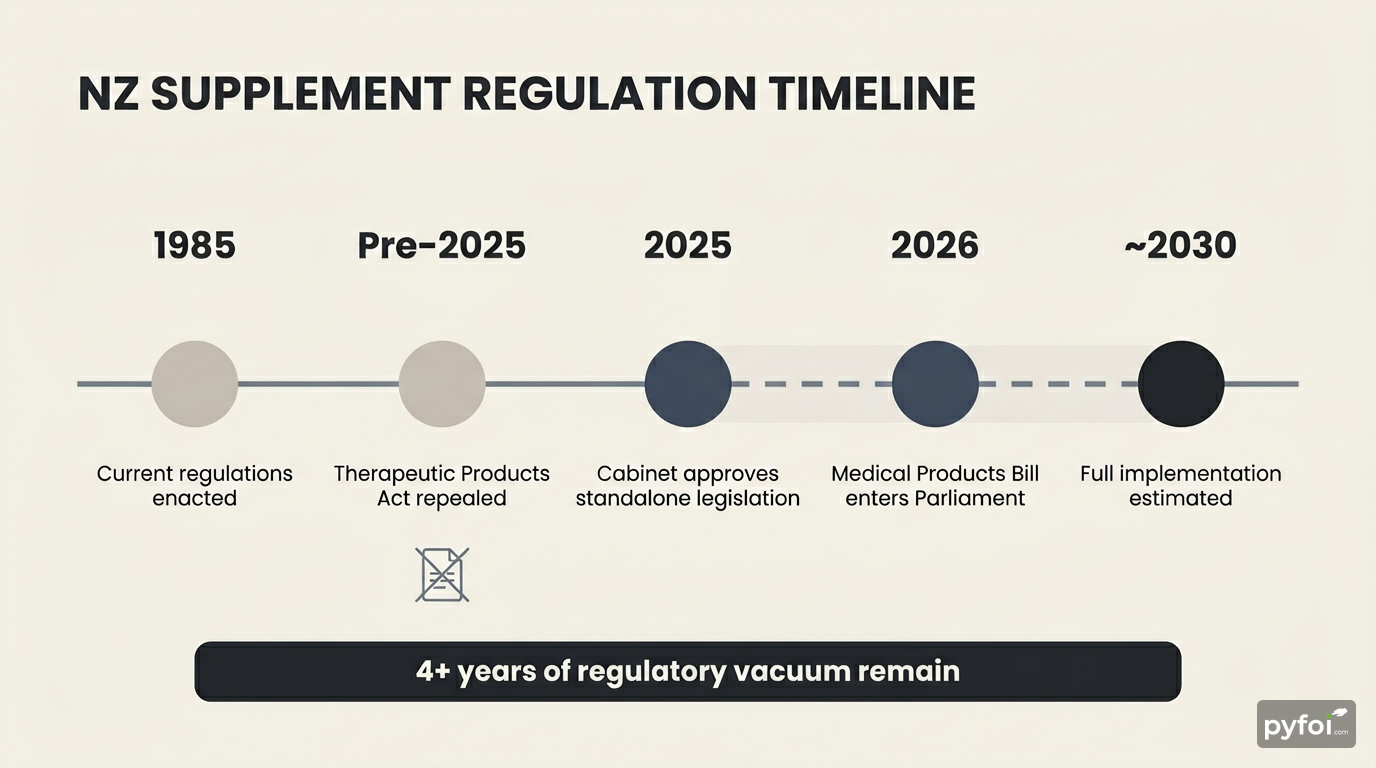
That timeline means at least four more years of the current vacuum. Here is how to navigate it.
Treat every label claim as unverified until proven otherwise. In a self-certification system, the burden of proof belongs to you, not the regulator.
Contact the brand directly. Ask for published structural verification of their liposomal claims. Companies with genuine liposomal technology are proud to share the data. Silence or deflection is your answer.
Compare regulatory standards across markets. Products that have passed scrutiny in stricter jurisdictions - the UK, EU, or Australia's TGA framework - carry more credibility than those sold only where oversight is minimal.
Do not wait for regulation to protect you. The brands doing liposomal delivery properly already exceed what New Zealand law requires. Find them, verify them, and buy from them. The regulatory gap is real, but it does not have to be your gap.
You may also be interested in these independent articles
Sources
- Regulation of Dietary Supplements - Medsafe, New Zealand
- Dietary Supplements Regulations 1985 - New Zealand Legislation
- Making Accurate Claims - Commerce Commission, New Zealand
- Regulating Medicines, Medical Devices and Natural Health Products - Ministry of Health NZ
- Documents on the Medical Products Bill - Ministry of Health NZ
- Therapeutic Products Act repealed - Buddle Findlay
- The NAD+ Liposome Problem - Nutraceutical Business Review, 2025
- YourZooki Ltd ASA Ruling - UK ASA
- Fake Liposomal Supplements - Top Sante, 2024
- Clinically proven: the power phrase reshaping consumer purchasing - SupplySide, 2025
© 2026 pyfoi. All rights reserved.