Example Independent Insights Articles
Here are some sample independent insight led articles
76 articles


Everything you need to know about liposomal delivery
Learn how liposomal delivery works, who benefits, and how to judge liposomal supplements in New Zealand.

The Hidden Tax on Every Supplement You Buy
Most shoppers compare supplements by milligrams and price per bottle. But the number that actually determines whether a supplement works - bioavailability - is nowhere on the label.

Paying Premium Prices for a Fake Liposomal Supplement?
Independent lab testing shows most liposomal supplements contain no real liposomes. Learn the four checks that separate genuine products from label-only fakes.

The Nutrient Gap Your Doctor Will Never Diagnose
A quarter of New Zealanders have inadequate zinc intake and a third are vitamin D deficient by winter. Learn why subclinical deficiency goes undiagnosed.

The Ageing Absorption Cliff After 50
After 50, your body absorbs less from every supplement you take. Learn why stomach acid loss, PPIs, and enzyme decline create a hidden nutrient gap.

Your Gut Is Quietly Sabotaging Your Supplements
64% of New Zealand adults have gut symptoms that silently reduce supplement absorption by 30-60%, making format choice more important than brand or dose.

Supplement Stacking Trap: Why More Is Less
Taking multiple supplements together creates absorption conflicts that reduce nutrient uptake. Learn how mineral competition wastes money and what formats avoid it.

The Start-Stop Supplement Trap That Costs You Thousands
Millions of supplement users quit because they feel nothing - then restart months later. The problem isn't the nutrient. It's how little of it your body ever absorbed in the first place.

Why Doubling Your Supplement Dose Is Not Doubling Your Results
Your body hits an absorption ceiling on most standard supplements. Escalating dose wastes money and delivers near-zero extra nutrient to your bloodstream.

Are You Trusting Regulations That Do Not Actually Exist?
New Zealand's supplement regulations date from 1985 and contain no provisions for liposomal claims. Every quality claim on the bottle is self-declared, with no pre-market approval and only complaint-driven enforcement.

The Double Deficit Hiding in New Zealand's Clean, Green Food
New Zealand's volcanic soils are naturally low in selenium, zinc, and iodine - meaning food grown here starts nutritionally behind. Standard supplements then fail to close the gap, creating a compounding deficit most Kiwis never see.

Is Your Liposomal Supplement Already Dead?
Liposomal supplements degrade through heat, light and oxidation before you open the bottle. Learn how to spot degraded products and protect your investment.
The Start-Stop Supplement Trap That Costs You Thousands
Millions of supplement users quit because they feel nothing - then restart months later. The problem isn't the nutrient. It's how little of it your body ever absorbed in the first place.
Sound familiar?
You buy a supplement. You take it daily for a few months - maybe longer. Nothing feels different. So you stop. Six months later, a friend mentions the same nutrient, or you read something that reignites the idea. You buy it again. Take it again. Stop again. Repeat.
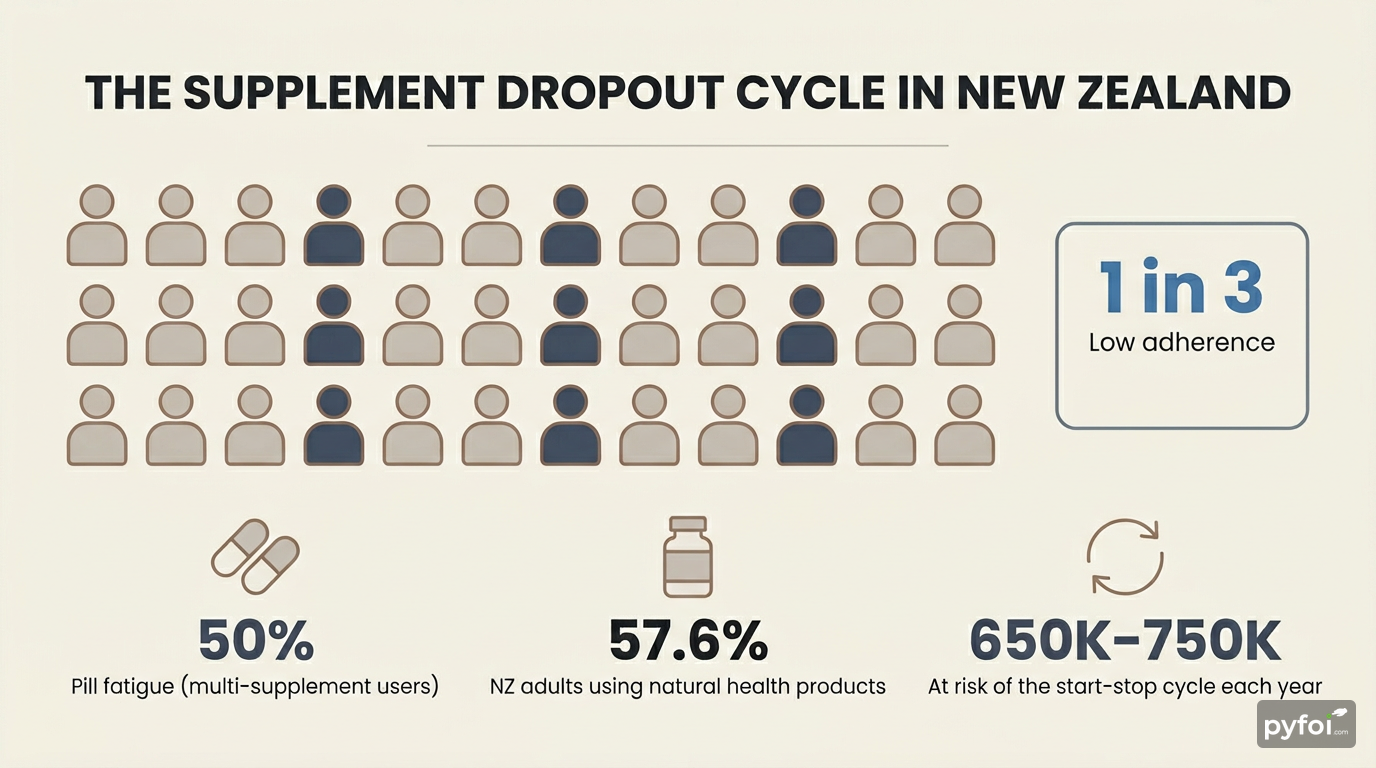
If you have lived this cycle, you are far from alone. Research shows roughly one in three supplement users has low adherence to their regimen [1], and about half of people taking multiple supplements experience pill fatigue [2]. In New Zealand, where 57.6% of adults use natural health products [6], that puts an estimated 650,000-750,000 people at risk of this pattern in any given year.
What if the supplement wasn't the problem?
Most people who quit blame the product. "Supplements don't work for me." But here is the part almost nobody considers: standard oral supplements can lose 50-84% of their active ingredient before it ever reaches your bloodstream. Your body never got to use what you paid for.
It is like hiring a plumber who only fixes half the pipes, then blaming the plumber when your taps still leak. The delivery failed.
This reframes the entire question. Instead of asking "do supplements work?" you should be asking: "did my body actually absorb enough to make a difference?" And more pointedly: "am I blaming the nutrient for a delivery format problem?"
The numbers behind each failed cycle
When you map out what each start-stop cycle actually costs, the waste is hard to ignore.
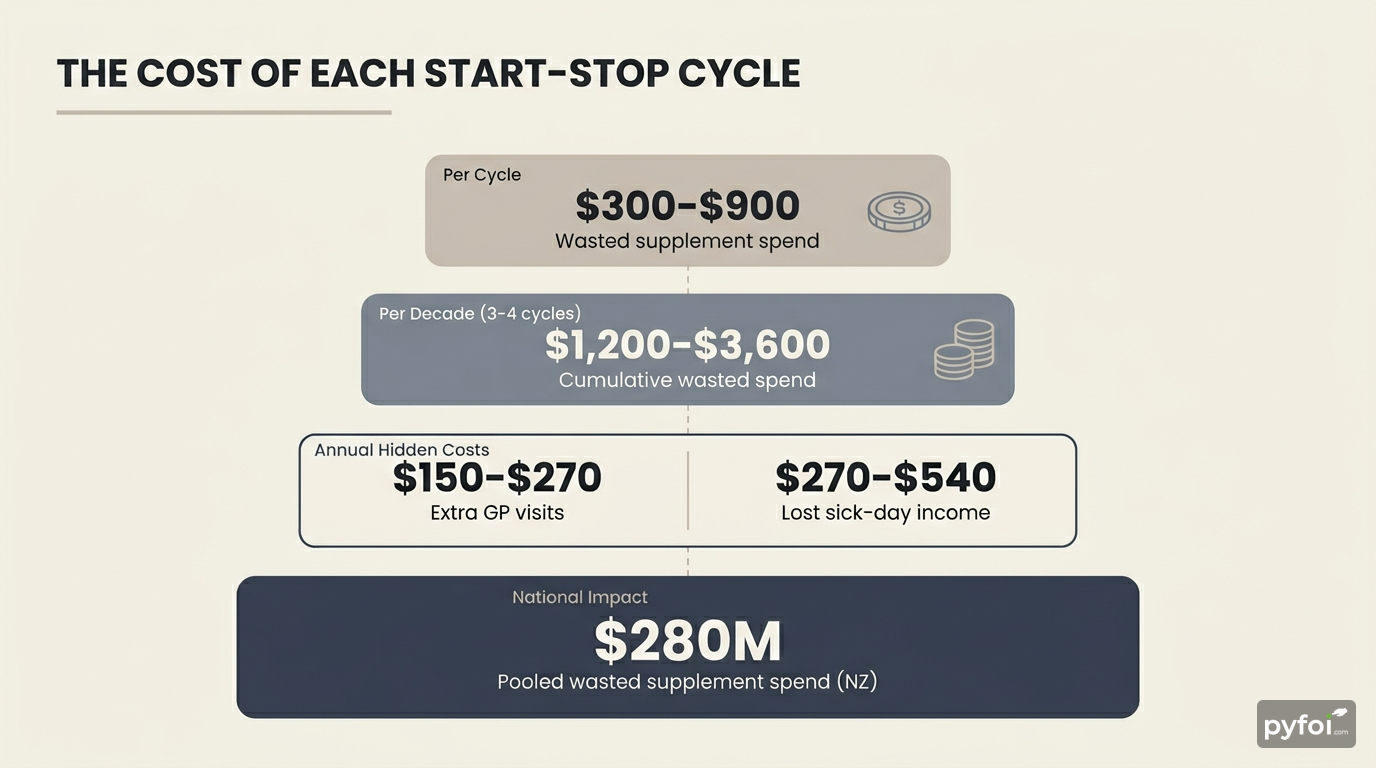
- At $20-$50 per month over 6-18 months, each cycle burns through $300-$900 in supplement purchases that delivered minimal absorbed benefit [9].
- Over a decade, a consumer who cycles three to four times may waste $1,200-$3,600 on supplements that never performed [9].
- Each dropout cycle carries forward health costs too - an estimated one to three extra GP visits per year at $50-$90 each ($150-$270 total) and one to two additional sick days ($270-$540 in lost income) [9][10][11].
- Multiply that across the at-risk population, and New Zealand is looking at roughly $280 million in pooled wasted supplement spend [9].
Meanwhile, 32% of New Zealand adults have suboptimal vitamin D levels [3], and widespread inadequacies in vitamin D, calcium, magnesium, omega-3, folate, and fibre persist across the population [4]. The nutrients are still needed. People just keep abandoning them.
What does this cycle actually feel like?
Imagine you have spent $600 over the past eighteen months on vitamin C and magnesium - two supplements you started because you were constantly run down. After a year and a half of daily capsules, you do not feel sharper, your energy has not shifted, and you are still catching every cold your kids bring home.
So you stop. You feel a mix of frustration and resignation. Maybe a quiet suspicion that the whole supplement industry is a con. That is not just lost money - it is lost trust. And the next time someone suggests you might benefit from vitamin C, you have already built a wall against it.
The irony is that your body genuinely needed those nutrients. It just never received enough of them to shift anything.
A smarter way to break the cycle
Before restarting any supplement - or quitting one - run through these checks:
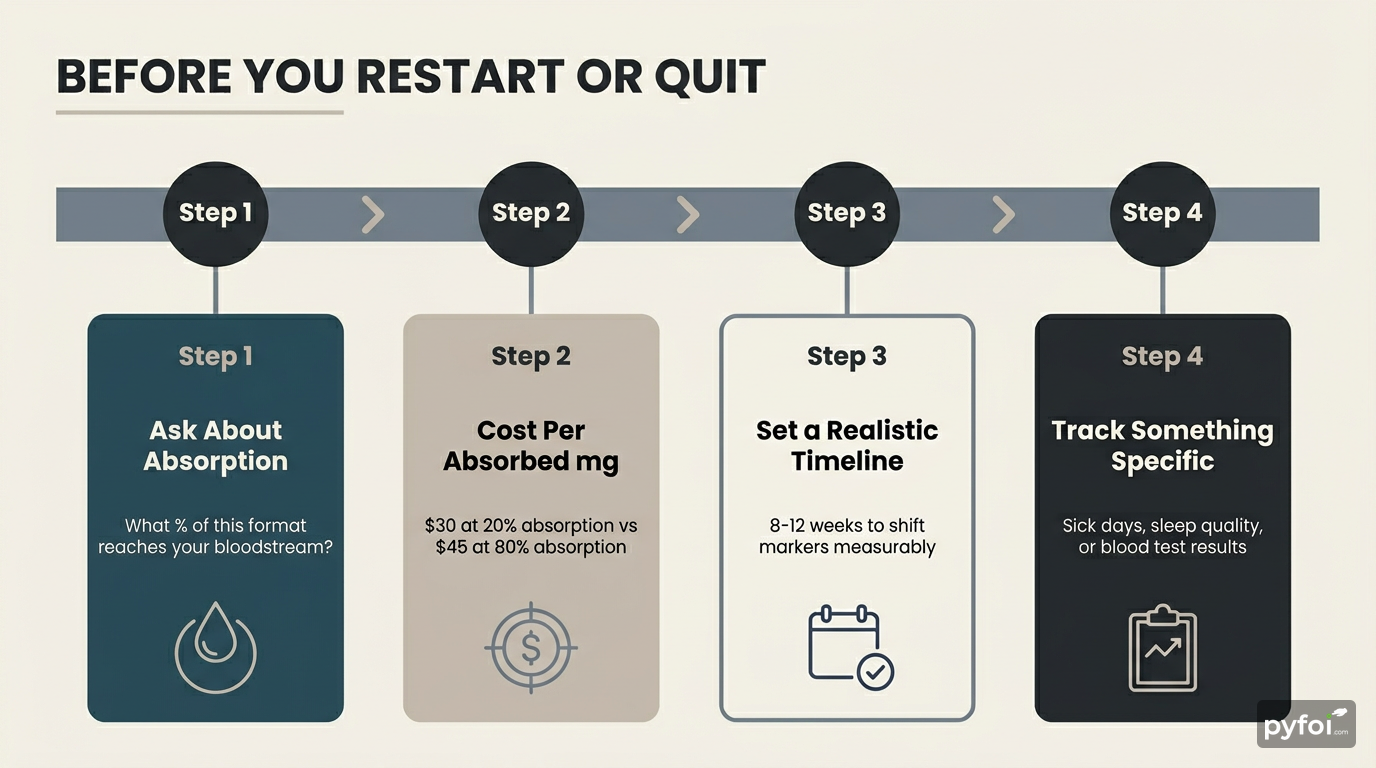
- Ask about absorption first. What percentage of this format actually reaches your bloodstream? If the answer is unknown or low, that is your starting problem.
- Calculate cost per absorbed milligram. A $30 bottle where you absorb 20% costs more per functional milligram than a $45 bottle where you absorb 80%.
- Set a realistic timeline. Some nutrients take 8-12 weeks to shift markers measurably. Quitting at week six guarantees you will never see results.
- Track something specific. Energy is vague. Instead, note sick days, sleep quality, or ask your GP for a blood test before and after three months.
How to stop wasting money and start getting results
Audit your supplement history. Write down every supplement you have started and stopped in the past five years. Estimate what you spent. If the total surprises you, the delivery format deserves scrutiny before the nutrient does.
Understand why absorption varies. Clinical trials show liposomal vitamin C produces 1.2-5.4 times higher peak blood concentrations than standard vitamin C at the same dose [12]. A 2025 trial found liposomal CoQ10 achieved 31.3% higher peak plasma levels [14]. The format changes what your body receives.
Match format to your circumstances. If you are over 50, have gut issues, or take multiple supplements, your baseline absorption is likely lower - making delivery format a bigger factor. For younger, healthy people taking a single low-dose vitamin, a standard capsule may be fine.
Do not double the dose to compensate. More milligrams through a poor delivery system still hits the same absorption ceiling. You are just paying more to waste more.
Talk to your pharmacist or GP before quitting. Ask whether a different format might change the equation. A conversation about bioavailability is worth more than another abandoned bottle in the cupboard.
The dropout loop is not a willpower problem. It is a delivery problem disguised as a supplement problem. Once you fix how much actually gets in, you can finally find out whether the nutrient itself makes a difference.
You may also be interested in these independent articles
Sources
- Quantity, Duration, Adherence, and Reasons for Dietary Supplement Use among Adults: NHANES 2011-2018 - PMC, 2024
- Less Is More: How reducing pill burden wins customers - Nutriventia
- Vitamin D deficiency, supplementation and testing - NZMJ, 2021
- Vitamin D Status of New Zealand Adults - Ministry of Health NZ
- Prevalence and Patterns of Use of Natural Health Products in New Zealand - PMC, 2021
- Hidden Cost analysis - File 04
- GP fees explained - 1News, 2024
- New Zealand Average and Median Wages and Salaries 2025 - MoneyHub NZ
- Liposomal delivery enhances absorption of vitamin C - PMC, 2024
- Impact of liposomal delivery on coenzyme Q10 absorption - Frontiers in Nutrition, 2025
© 2026 pyfoi. All rights reserved.