Example Independent Insights Articles
Here are some sample independent insight led articles
76 articles


Everything you need to know about liposomal delivery
Learn how liposomal delivery works, who benefits, and how to judge liposomal supplements in New Zealand.

The Hidden Tax on Every Supplement You Buy
Most shoppers compare supplements by milligrams and price per bottle. But the number that actually determines whether a supplement works - bioavailability - is nowhere on the label.

Paying Premium Prices for a Fake Liposomal Supplement?
Independent lab testing shows most liposomal supplements contain no real liposomes. Learn the four checks that separate genuine products from label-only fakes.

The Nutrient Gap Your Doctor Will Never Diagnose
A quarter of New Zealanders have inadequate zinc intake and a third are vitamin D deficient by winter. Learn why subclinical deficiency goes undiagnosed.

The Ageing Absorption Cliff After 50
After 50, your body absorbs less from every supplement you take. Learn why stomach acid loss, PPIs, and enzyme decline create a hidden nutrient gap.

Your Gut Is Quietly Sabotaging Your Supplements
64% of New Zealand adults have gut symptoms that silently reduce supplement absorption by 30-60%, making format choice more important than brand or dose.

Supplement Stacking Trap: Why More Is Less
Taking multiple supplements together creates absorption conflicts that reduce nutrient uptake. Learn how mineral competition wastes money and what formats avoid it.

The Start-Stop Supplement Trap That Costs You Thousands
Millions of supplement users quit because they feel nothing - then restart months later. The problem isn't the nutrient. It's how little of it your body ever absorbed in the first place.

Why Doubling Your Supplement Dose Is Not Doubling Your Results
Your body hits an absorption ceiling on most standard supplements. Escalating dose wastes money and delivers near-zero extra nutrient to your bloodstream.

Are You Trusting Regulations That Do Not Actually Exist?
New Zealand's supplement regulations date from 1985 and contain no provisions for liposomal claims. Every quality claim on the bottle is self-declared, with no pre-market approval and only complaint-driven enforcement.

The Double Deficit Hiding in New Zealand's Clean, Green Food
New Zealand's volcanic soils are naturally low in selenium, zinc, and iodine - meaning food grown here starts nutritionally behind. Standard supplements then fail to close the gap, creating a compounding deficit most Kiwis never see.

Is Your Liposomal Supplement Already Dead?
Liposomal supplements degrade through heat, light and oxidation before you open the bottle. Learn how to spot degraded products and protect your investment.
Why Taking More Supplements Is Making Each One Work Less
Taking multiple supplements together creates absorption conflicts that reduce nutrient uptake. Learn how mineral competition wastes money and what formats avoid it.
Sound familiar?
You have done the research. You take calcium for bones, magnesium for sleep, zinc for immunity, iron for energy, maybe a multivitamin to cover the gaps. Five or six bottles lined up on the kitchen bench, a handful of capsules every morning. You are doing everything right - or so it seems.
But three months in, you feel about the same. So you add another product. The stack grows, the cost climbs, and eventually the morning ritual starts feeling like a chore. You miss a day. Then a week. Then you quietly stop altogether and wonder whether supplements ever worked in the first place.
What if your supplements are cancelling each other out?
Here is the part almost nobody talks about: many common supplements actively compete with each other for absorption. Your body has a limited number of transport pathways in the small intestine, and several minerals - calcium, magnesium, zinc, and iron - all rely on the same ones [1][2].
When you swallow them together, they fight for the same entry points. The result is not a team effort. It is a traffic jam.
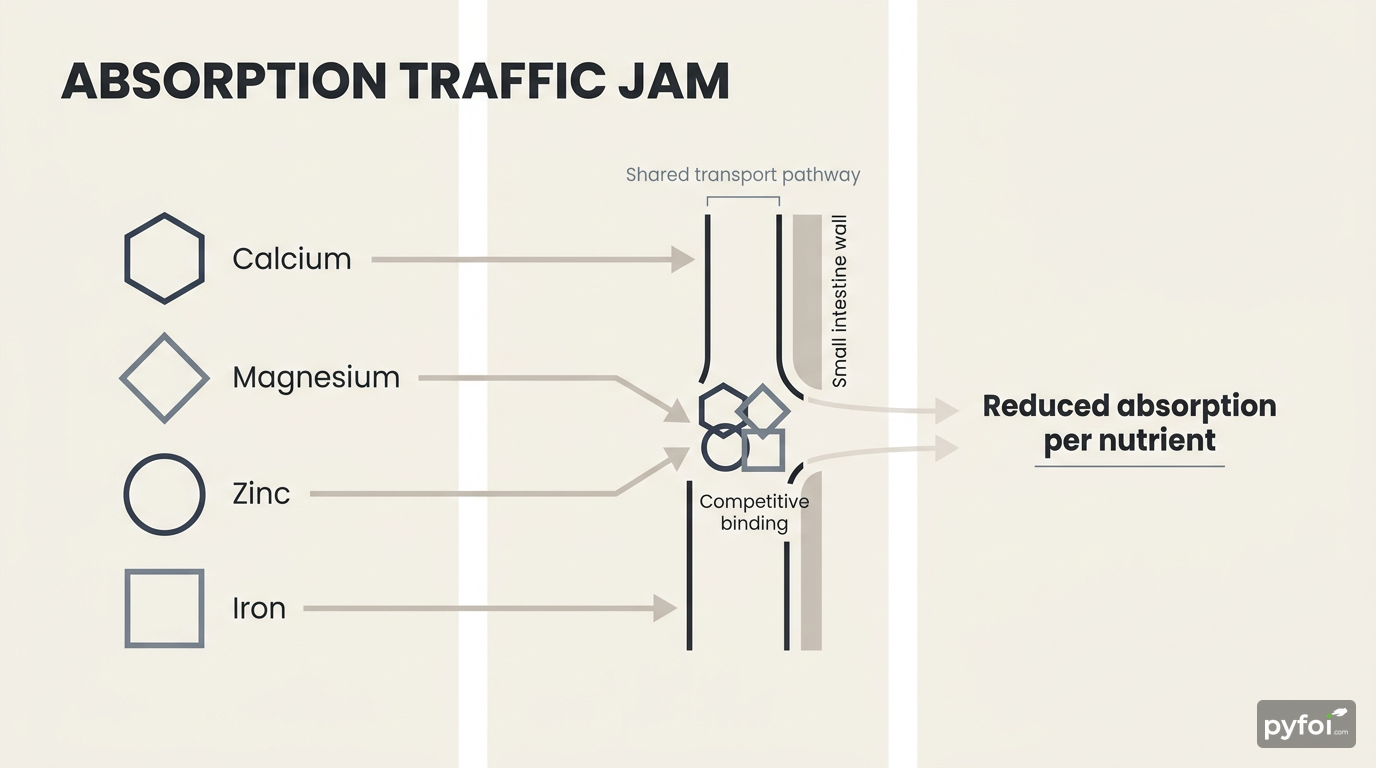
Think of it like merging five lanes of motorway traffic into one. The more vehicles you add, the slower every single one moves.
Instead of asking "what else should I add?", the better questions are: are my current supplements actually reaching my bloodstream? Am I creating absorption conflicts? And is there a simpler format that sidesteps this entirely?
The numbers behind the conflict
The interference between co-administered supplements is well documented - and the losses are significant:
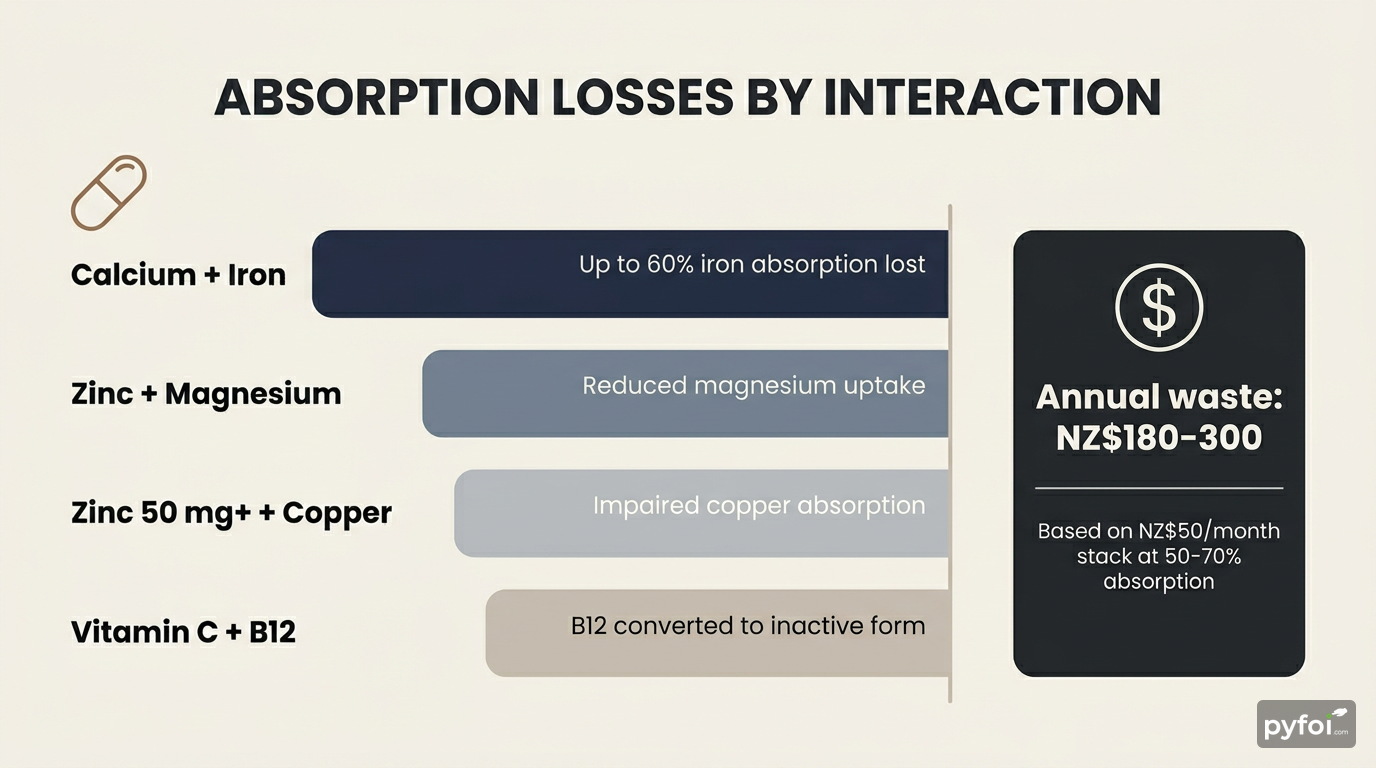
- Calcium reduces iron absorption by up to 60% when taken at the same time [2]. That iron supplement you take for energy may be delivering less than half its labelled dose.
- Zinc supplementation decreases magnesium absorption, meaning your sleep or muscle-recovery stack may be undermining itself [2].
- High-dose zinc (50 mg+ per day) impairs copper absorption, creating a secondary deficiency you never intended [2].
- Vitamin C can convert active B12 into inactive analogues, potentially reducing the value of your B-complex [1].
- A consumer spending NZ$50 per month on a typical multi-supplement stack may be achieving only 50-70% of expected absorption per nutrient - that is NZ$180-300 per year in reduced value [1].
You are not just losing efficacy. You are paying full price for partial delivery.
What the supplement treadmill actually feels like
Picture this: you started with one or two supplements that seemed to help. Over time, you read about magnesium for sleep, zinc for winter immunity, vitamin D because you live south of Auckland. Your stack grew to four, then five products. Monthly cost crept past $50.
At first, you were disciplined. But managing five different bottles with different timing rules - some with food, some without, some separated by two hours - became exhausting. You started doubling up to save time, taking everything at once. Results faded. Motivation followed.
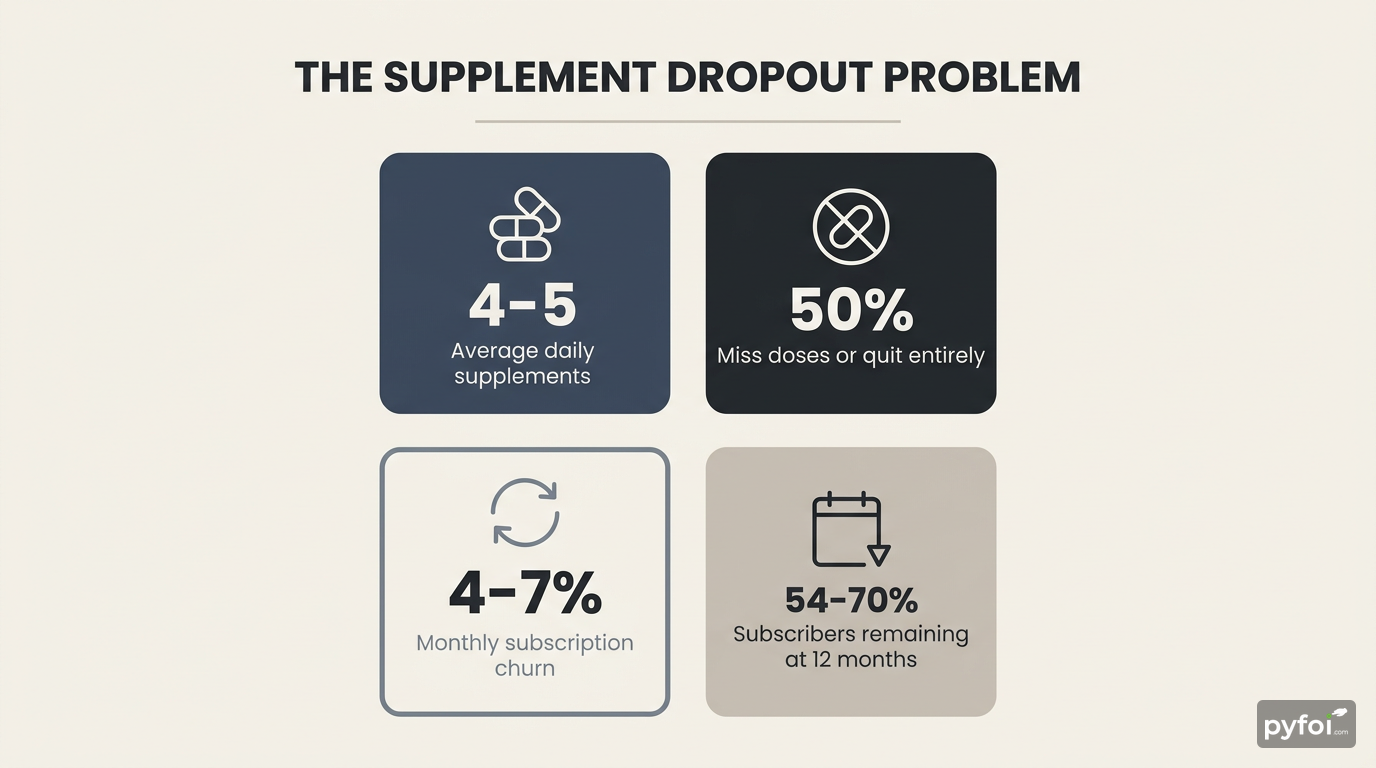
You are not alone. The average supplement user now stacks four to five products daily [3]. Approximately 50% of multi-pill users miss doses or quit entirely because of pill fatigue [4]. Monthly supplement subscription churn runs at 4-7%, meaning only 54-70% of subscribers remain after twelve months [5].
The stack was supposed to optimise your health. Instead, it optimised your chances of giving up.
Is there a simpler approach?
If your current routine involves multiple competing supplements, consider these filters before your next purchase:
- Fewer products, better format. A single well-formulated product that combines key nutrients in a format designed to avoid absorption conflicts will outperform a five-bottle stack where minerals fight each other at the gut wall.
- Delivery method matters more than dose. Liposomal formats encapsulate nutrients in phospholipid layers, allowing them to bypass the competitive transporter pathways that cause interference in standard capsules [6].
- Timing is not a full fix. Separating doses across the day helps, but it also multiplies complexity - and complexity drives dropout.
How to escape the stacking trap
Audit your current stack honestly. List every supplement you take. Check which ones share absorption pathways - calcium, magnesium, zinc, and iron are the main offenders [2]. If you are taking two or more of these together, you have an absorption conflict.
Calculate your real cost. If absorption interference means you are getting 50-70% of each nutrient, your effective cost per milligram absorbed is much higher than you assumed.
Consider consolidation. A 2025 pharmacokinetic crossover trial demonstrated significantly enhanced absorption for multiple nutrients in liposomal multinutrient formulations compared to standard alternatives [6]. One product replacing three or four eliminates the conflict problem entirely.
Simplify to stick with it. The best supplement routine is one you actually maintain. If your current stack requires a spreadsheet to manage, that is a design flaw - not a discipline problem.
Talk to your pharmacist about format, not just ingredients. Ask: "If I am taking these four supplements together, which ones are competing for absorption - and is there a format that avoids that?" If they cannot answer, look for one who can.
The goal was never to take more supplements. It was to absorb more of what you take. Fewer products in a smarter format will get you closer than a benchtop full of bottles ever will.
You may also be interested in these independent articles
Sources
- Supplement Stacking: The Smart Way to Combine Vitamins - Clinikally
- Micronutrient interactions: effects on absorption and bioavailability - Cambridge University Press
- 2025's hottest supplements are in - Longevity Technology, 2025
- Less Is More: How reducing pill burden wins customers - Nutriventia
- Subscription Drop-Off? How to Boost Retention - Fusion CX
- Pharmacokinetics of liposomal multinutrients versus non-liposomal comparators - ScienceDirect, 2025
© 2026 pyfoi. All rights reserved.